
Digital SAT vs. the ACT: Which Test Should You Take?

Understand the format, scoring, and strategy to make the best choice for your future.

One of the key components of college admissions is standardized testing. However, students often face a dilemma when choosing between the SAT and ACT, as both are equally accepted by colleges.
Colleges across the world widely accept both tests, but they differ significantly in format, timing, content, and overall approach. This guide will help you understand the key differences between these two exams so you can make an informed decision about which one might better showcase your strengths.

The Bottom Line: You Need to Take One
Before diving into the differences, let's address the most important point: if you're planning to apply to selective colleges, taking either the SAT or ACT is essentially mandatory. As Princeton Review's editor-in-chief Rob Franek emphasizes, "This is not a suggestion. This is an absolute necessity."
There are only two rare scenarios where you might not need test scores:
You're applying exclusively to schools with "test-blind" admission policies
You have an absolute promise of admission from a school stating no test scores are needed
For virtually all other scenarios, especially if you're targeting competitive schools or hoping for merit scholarships, you'll need to submit either SAT or ACT scores.

Time and Structure: The Big Picture
One of the most notable differences between these tests is their timing and overall structure:
Digital SAT:
Total testing time: 2 hours 14 minutes
98 total questions (71 seconds per question for Reading & Writing sections & 95 seconds per question for Math section)
Two main sections: Reading & Writing and Math (each divided into two modules)
Adaptive testing: performance on the first module determines difficulty of the second module

ACT:
Total testing time: 2 hours 55 minutes (41 minutes longer)
215 total questions (36-60 seconds per question)
Four sections: English, Math, Reading, Science (plus optional Essay)
Linear format (non-adaptive)
If time is a consideration for you, the SAT's shorter format might be appealing. However, the ACT's linear structure might be easier to navigate for some students.
Format: Paper vs. Digital
Another fundamental difference between these tests is their delivery format:
Digital SAT:
Offered exclusively on computer or tablet in the Bluebook App.

Adaptive testing means questions adjust to your performance level
If you perform poorly on the first module and get routed to an easier second module, your maximum possible score is capped (around 620-660 per section)
ACT:
Primarily offered in paper format on national test dates
Some digital options available in certain locations
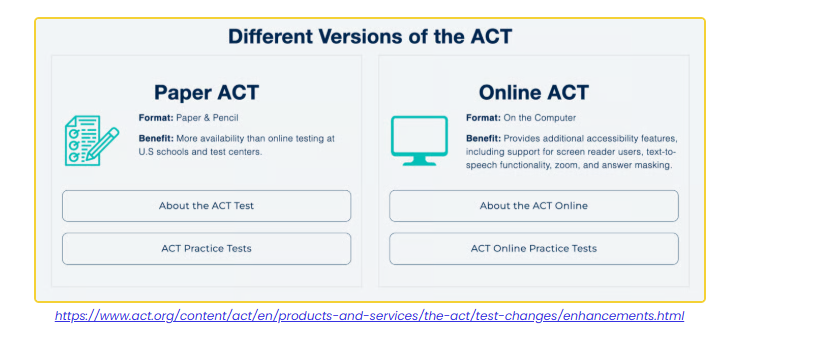
No adaptive elements—everyone takes the same test
Research suggests that some students focus better and read more efficiently on paper than on screens. This may be especially relevant for students with attention difficulties or learning differences. If you struggle with screen fatigue or digital distractions, the paper-based ACT might be worth considering.

Content Comparison by Section
Reading/English
Digital SAT:
Paragraph-length passages rather than full pages

Higher reading level (10th grade to college level)
Includes poetry and literature excerpts
Tests "nuance" and selecting the "best" answer among close options
More complex grammar questions, particularly with sentence structure and punctuation
ACT:
Full-page passages

Generally more straightforward reading level
More direct "scavenger hunt" style questions with clearer right/wrong answers
English section (grammar) is considered one of the easiest sections to improve with practice
More questions overall but less complex interpretation required
If you excel at analyzing nuance and can handle higher-level reading passages, the SAT might play to your strengths. If you prefer more straightforward questions and can work quickly through clear-cut tasks, the ACT might be better.

Math
Digital SAT:
Heavy focus on algebra and abstract thinking

Fewer different types of problems, but often more challenging conceptually
Built-in Desmos calculator available
Rewards creative approaches and shortcuts
ACT:
Broader coverage of topics including more geometry and trigonometry

Described as a "final exam for every class you've ever taken"
More straightforward but covers more math topics
Rewards diligent preparation across many subject areas
Your math strengths should guide this decision. If algebra is your strong suit and you enjoy problem-solving through creative approaches, the SAT math might suit you better. If you're strong in geometry/trigonometry and prefer more straightforward (but faster-paced) questions, the ACT could be advantageous.

Science
Digital SAT:
No dedicated science section
Incorporates science-related reading passages and data analysis throughout the reading section
Includes "command of evidence" questions that test graph and chart interpretation
ACT:
Dedicated science section (but doesn't require extensive science knowledge & the science section will be optional starting in September 2025.)

Heavy focus on interpreting graphs, charts, and experimental designs
Works well for students who can quickly analyze visual data
If interpreting scientific data and experiments comes naturally to you, you might excel at the ACT science section. If these types of questions challenge you, the SAT's more limited approach to science might be preferable.


Scoring Considerations
Both tests are scored differently but are considered equally by college admissions offices:
Digital SAT:
Scored on a scale of 400-1600
Two section scores: Evidence-Based Reading & Writing (200-800) and Math (200-800)
Score Superscoring
Superscoring is a policy some colleges use to combine your highest section scores from multiple SAT attempts to create your best possible composite score.
How It Works:The SAT consists of two main sections:
Evidence-Based Reading and Writing (EBRW)
Math
If you take the SAT multiple times, a college practicing superscoring will select your highest score from each section across all attempts and combine them.
Example:
First Attempt: EBRW: 650, Math: 700 (Total: 1350)
Second Attempt: EBRW: 680, Math: 670 (Total: 1350)
With superscoring, the college considers:
EBRW: 680 (from the second attempt)
Math: 700 (from the first attempt)
Superscored Total: 1380

ACT:
Scored on a scale of 1-36
Composite score is the average of all four sections
Based on test prep experts' observations:
Students scoring below 1000 on the SAT may find it easier to improve on the ACT
High-scoring students often find the SAT better aligns with their strengths
Students aiming for National Merit recognition often choose the SAT/PSAT pathway

Special Considerations
For Students with Test Anxiety
Both tests can trigger anxiety, but practice helps. Taking full-length practice tests under realistic conditions helps build mental stamina and reduces test-day stress. Remember that standardized tests are designed to be challenging, so feeling some stress is normal.
For Students with Accommodations
If you receive testing accommodations like extended time:
ACT may be more advantageous since the additional time often makes the traditionally time-pressured sections much more manageable
Paper format might be easier for focus than the digital format
For Students Applying to Elite Colleges
For highly selective schools, even those with test-optional policies, competitive applicants typically submit strong test scores. These institutions want to see that you excel across all metrics—grades, essays, extracurricular activities, and standardized tests.

How to Decide?
The most reliable way to determine which test is right for you is to take official practice tests for both the Digital SAT and ACT. Compare your scores using concordance tables (available online) to see which test gives you the higher comparative score.
When taking practice tests:
Use official materials from College Board (SAT) and ACT, Inc.
Time yourself accurately
Take the tests in their entirety
Analyze your results section by section
Pay attention not just to scores but to how you felt taking each test
If your scores are similar on both tests, consider:
Which test felt more comfortable?
Which test's question style aligns better with your thinking?
Which test's timing worked better for you?
Which test's format (digital vs. paper) did you prefer?
Summarised View

Final Thoughts
Remember that colleges view SAT and ACT scores as equivalent, so there's no advantage to taking one test over the other from an admissions perspective. The best test for you is the one you'll score higher on and feel more comfortable preparing for.
Whichever test you choose, preparation is essential. Both the SAT and ACT are highly coachable tests, and dedicated practice can significantly improve your scores. Consider your personal learning style, strengths, and preferences when making your decision.
Most importantly, don't procrastinate. Take practice tests early, make your decision, and give yourself plenty of time to prepare thoroughly. With the right approach and adequate preparation, you can achieve your best possible score on either test—bringing you one step closer to your college goals.




Comments