
How to Create a Powerful LinkedIn Profile in High School

Craft a Professional Presence and Get Noticed by Top Universities. [Bonus checklist at the end]

Should high school students use LinkedIn?
Yes, absolutely. While LinkedIn is traditionally viewed as a platform for professionals, it offers significant value for high school students as a strategic advantage. With college admissions and early career development evolving rapidly, admissions officers, scholarship committees, and mentors increasingly look beyond traditional applications to understand applicants more completely. LinkedIn provides a professional digital presence that showcases achievements and potential in ways resumes cannot.
Forward-thinking high school students are establishing LinkedIn profiles earlier than ever, but most guidance targets working professionals rather than students building foundations for future opportunities.
This guide provides high school students with strategies to create impactful profiles highlighting academic achievements, extracurricular activities, and aspirations while fostering valuable connections.

Building a Strong LinkedIn Profile for High School Students
Starting from Scratch
When creating your LinkedIn profile as a high school student, focus on the sections most relevant to your experience and goals. Don't worry about leaving some sections blank—it's better to have quality content in a few sections than to stretch thin content across many.
Before diving into each section in detail, let’s first understand the essential sections of a LinkedIn profile.

Profile Photo

Your profile photo makes your first impression. While you don't need professional headshots, you should:
Use a clear, front-facing photo with good lighting
Maintain a neutral background
Dress appropriately (business casual is typically sufficient)
Ensure your face takes up about 60% of the frame
Smile naturally
Remember, this isn't Instagram or Snapchat—filters, group photos, or overly casual images don't convey professionalism.
Background Graphic

The background graphic offers an opportunity to personalize your profile. Consider using:
Your school colors or mascot
A relevant academic or extracurricular theme
A simple, professional design with motivational quotes
A photo of your school or a place significant to your academic journey
Free design tools like Canva offer templates specifically for LinkedIn backgrounds.
Headline

Your headline appears directly below your name and is highly visible. For high school students, effective headlines include:
"High School Junior at [School Name] | Aspiring [Career Interest]"
"Student Leader | Environmental Advocate | Future Marine Biologist"
"High School Student passionate about Computer Science and Artificial Intelligence"
The headline should succinctly communicate your current status and future direction.
About Section

The About section is your opportunity to tell your story—similar to a college essay but more professionally focused. In 3-5 short paragraphs:
Introduce yourself and your academic focus
Highlight key achievements and interests
Explain what drives your passion for your chosen field
Mention future educational or career goals
Conclude with a call to action for potential connections
Write in first person and keep your tone professional yet authentic.
Featured Section

The Featured section showcases your best work. Consider including:
Links to projects you've created
Articles you've written for school publications
Presentations you've delivered
Videos of performances or competitions
School newspaper articles mentioning your achievements
Digital portfolios of artwork, writing, or coding projects
This section provides tangible evidence of your capabilities and interests.

Work & Volunteer Experience

Don't worry if you haven't had formal employment. Include:
Part-time jobs and responsibilities
Volunteer work and community service
Babysitting or lawn care services
Family business participation
For each entry, focus on responsibilities and achievements rather than just duties.
Quantify your impact where possible: "Organized a fundraiser that collected $2,000 for local food banks" carries more weight than "Helped with fundraising."
Education

List your current high school with expected graduation date. Also include:
Academic focus or track (e.g., STEM, Humanities, IB)
Relevant coursework, especially advanced classes
GPA (if strong)
Summer programs or enrichment experiences
Online courses or certifications
Honors & Awards

Document recognitions you've received:
Academic honors (Honor Roll, National Merit recognition)
Competition awards (Science Fair, Math Olympiad)
School-specific recognitions
Community awards
Athletic achievements
Include the issuing organization and date for each honor.
Projects

The Projects section demonstrates your initiative and leadership:
Research projects
School newspaper or yearbook contributions
Coding or engineering projects
Art portfolios or performances
Community initiatives you've led
For each project, explain your role, the objective, and the outcome or impact.
Courses
List courses relevant to your future career interests, particularly:
Advanced Placement (AP) or International Baccalaureate (IB) courses
College-level courses
Specialized electives
Online courses from platforms like Coursera or edX
Summer academic programs
Skills

Don't underestimate the skills you've developed through school and extracurricular activities:
Technical skills (programming languages, design software, lab techniques)
Language proficiencies
Research methods
Public speaking
Leadership abilities
Analytical thinking
Aim for a mix of hard skills (technical abilities) and soft skills (interpersonal capabilities).

Document your involvement in:
School clubs and positions held
Sports teams and leadership roles
Community organizations
Religious groups or volunteer organizations
Honor societies
For each, mention your role and significant contributions.
Languages

List all languages you speak, with accurate proficiency levels:
Native or bilingual proficiency
Full professional proficiency
Professional working proficiency
Limited working proficiency
Elementary proficiency
Be honest about your fluency level.
Now that you know how to build a strong LinkedIn profile, it’s time to learn how to make the most of it. Let’s explore that in the next section.
Which part of a LinkedIn profile do you think high school students struggle with most? |
Leveraging LinkedIn as a High School Student
Networking Strategies

LinkedIn's true power lies in connections. As a high school student:
Connect with teachers, counselors, and school administrators
Add family friends in professional fields of interest
Join LinkedIn groups related to academic interests or future career paths
Follow colleges and universities you're considering
Connect with alumni from your high school who are in college or careers of interest
When sending connection requests, always add a personalized note explaining why you'd like to connect.
Research Opportunities

LinkedIn provides invaluable resources for exploring future paths:
Research universities by following their official pages
Explore career paths by examining profiles of professionals in fields of interest
Identify skills and experiences needed for specific careers
Find potential mentors in your areas of interest
Discover internship opportunities through company pages
Use LinkedIn's search features to find professionals who graduated from your high school or local colleges.
Internship Hunting

While most internships target college students, LinkedIn can help you find opportunities appropriate for high schoolers:
Remote internships with flexible hours
Summer opportunities specifically for high school students
Job shadowing experiences
Volunteer positions that build relevant skills
Follow companies you're interested in, and use the Jobs feature with filters for "internship" and "entry-level."
Now, let’s move on to our final and very important topic: how to consistently maintain a strong LinkedIn profile.
Maintaining Your LinkedIn Presence
Regular Engagement
LinkedIn doesn't require daily attention, but plan for regular engagement:
Set aside 15 minutes weekly for profile updates and network engagement
Respond promptly to messages and connection requests
Share relevant content, such as articles related to your interests
Congratulate connections on achievements and milestones
Comment thoughtfully on posts from schools, companies, or professionals you follow
Annual Profile Updates
Schedule a comprehensive profile review annually:
Add new accomplishments, courses, and skills
Update your headline and About section to reflect your development
Refresh your profile photo if needed
Remove outdated information
Request recommendations from teachers or activity leaders
Additional Resources
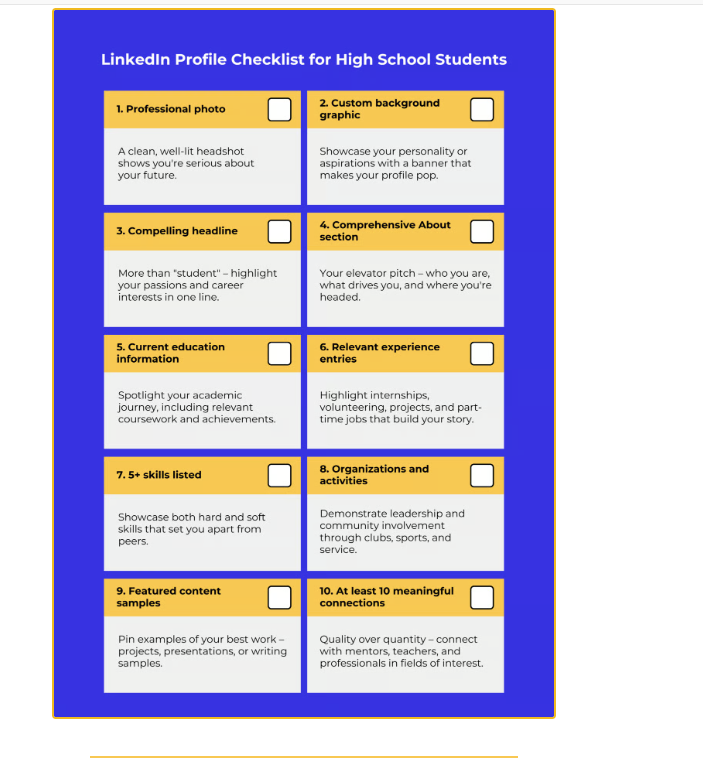
LinkedIn Profile Checklist for High School Students
Conclusion
Creating a LinkedIn profile in high school is an investment in your future professional identity. While your peers may be focusing exclusively on other social media platforms, establishing a LinkedIn presence demonstrates maturity and forward thinking that distinguishes you from other college applicants and future job seekers.
The early adoption of LinkedIn provides several long-term advantages:
A documented history of your academic and extracurricular journey
Established connections with professionals and mentors
Familiarity with professional networking norms and expectations
A platform to showcase achievements beyond what fits on a college application
Early exposure to potential career paths and opportunities
Your LinkedIn profile will evolve as you progress through high school, college, and beyond, but starting early gives you a significant advantage. The connections you make now—with teachers, family friends, and community members—can develop into valuable professional relationships that might one day lead to internships, job opportunities, or important introductions.



Comments