
Top 10 New Age Degrees for the Future

Updated: 31 minutes ago
Degrees That Will Shape Careers in 2030 and Beyond!

When you consider which degree to pursue, you're likely asking yourself: "Will this field still be relevant in five or ten years? Will it provide financial stability and professional fulfillment?" These are valid concerns in our rapidly evolving economy.
The good news is that certain fields show exceptional promise for sustainable growth, innovation, and compensation. We've curated 10 of the most forward-thinking degree programs that balance strong job prospects with compelling earning potential.
Whether you're drawn to healthcare, technology, engineering, or creative fields, this guide highlights programs designed to position graduates at the forefront of tomorrow's economy. Each section includes not only what you'll learn but also which reputable institutions offer standout programs in these emerging disciplines.

1. Sustainable and Renewable Energy

This field prepares you to lead the green economy transition. While bachelor's programs specifically in this area are limited, you can pursue related fields like ecology or ocean science. Coursework typically covers dynamic weather systems, green economic principles, and solar energy innovations. Most graduates either continue to graduate school or enter scientific and technical roles. The job market offers strong growth potential and competitive salaries, though advanced degrees may be required for certain positions.
Colleges offering this program:
2. Game Design

Transform your gaming passion into a career by creating the games you love. Major companies like Nintendo, Microsoft, and Sony actively recruit game designers with specialized training. Your coursework will include 3D modeling, animation techniques, graphics engine development, and virtual reality applications. You can also specialize in areas like mobile game design or game art. The industry boasts excellent job prospects with numerous openings, making it one of today's most promising career paths.
Colleges offering this program:
3. Epidemiology

This discipline focuses on understanding disease patterns—their causes, spread, and prevention methods. Your studies will blend science coursework with laboratory experience, covering topics such as biostatistics, chronic disease management, community health initiatives, and public health fundamentals. While a graduate degree is typically needed for laboratory, pharmaceutical, or public health agency positions, the field rewards graduates with strong job growth and attractive compensation.
Colleges offering this program:

4. Robotics and Autonomous Systems

Launch your robotics career by mastering the intersection of computing and engineering. Bachelor's programs in this field teach you to design, program, and operate robotic systems while developing troubleshooting skills. If you excelled in high school math and physics, this could be an ideal path. The automotive industry alone hires thousands of robotics engineers annually, offering excellent job security and compensation for the foreseeable future.
Colleges offering this program:
5. Health Information Technology (HIT)

This program blends healthcare knowledge with technical expertise, teaching you to analyze, process, and manage sensitive medical information. Your 120-credit bachelor's program will include coursework in critical thinking, healthcare data management, health law and ethics, and computer fundamentals. You'll also complete an internship or field experience before graduation. The career outlook is excellent—HIT managers earn approximately $100,000 annually, with strong projected job growth.
As healthcare systems become increasingly digital, emerging technologies such as healthcare agents are also becoming part of the broader healthcare technology landscape. These systems can support tasks such as information management, communication, and routine healthcare workflows.
Colleges offering this program:
6.Internet of Things (IoT)

IoT programs teach you how interconnected smart devices communicate—from watches to home security systems. You'll develop critical thinking and troubleshooting skills while exploring cybersecurity, data analysis, computer design fundamentals, and IoT sensors. This versatile training prepares you for positions across multiple industries, including energy, medicine, and transportation, all of which actively recruit IoT specialists.
Colleges offering this program:

7. Artificial Intelligence
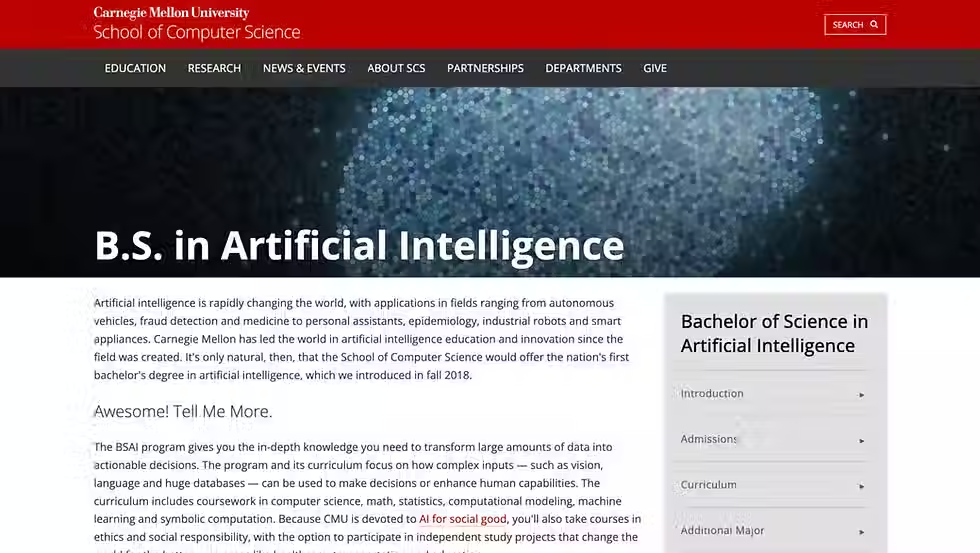
AI professionals command impressive salaries ranging from $96,000 to $200,000 annually, with thousands of new positions opening each year. Your curriculum will include computer vision, ethics, and functional programming, supplemented by seminars and research projects. This comprehensive preparation positions you for some of the most innovative and well-compensated roles in the technology sector.
For students interested in building practical AI solutions, Forward Deployed Engineering is another emerging career path that combines AI, software engineering, and real-world problem solving.
Colleges offering this program:
8. Entrepreneurship and Innovation

Designed to cultivate entrepreneurial thinking, this program blends business, design, and finance to prepare students for the startup world. Courses cover venture creation, innovation strategies, and financial modeling, equipping students with the skills to launch and scale businesses. Graduates frequently enter fields such as venture capital, product development, or social entrepreneurship, benefiting from strong industry networks and mentorship opportunities.
Colleges offering this program:
Social Impact and Equity

This program trains students to drive meaningful change by addressing social justice and inclusivity. With a focus on ethical leadership and community engagement, coursework includes topics like human rights law, economic equity, and impact assessment. Graduates often work in nonprofits, international organizations, or corporate social responsibility roles, leveraging their expertise to create a more equitable world.
Colleges offering this program:
Which emerging field excites you the most for the future? 🚀 |
10. Space Engineering and Astrodynamics

This cutting-edge field prepares students for careers in space exploration, satellite design, and orbital mechanics. You'll develop expertise in spacecraft systems, propulsion technologies, celestial mechanics, and mission planning.
The curriculum balances theoretical physics with practical engineering applications, including simulation software, materials science, and autonomous systems design. With the space industry's rapid growth through companies like SpaceX and Blue Origin alongside traditional employers like NASA and defense contractors, graduates enjoy exceptional career prospects.
Entry-level positions start around $80,000, with experienced professionals earning well over $150,000 annually as the commercial space sector continues its unprecedented expansion.
Colleges offering this program:
Final Words
As you consider these promising degree paths, remember that the most successful career journeys align personal passion with market opportunity. While these 10 fields demonstrate strong growth trajectories and earning potential, your individual strengths, interests, and goals should ultimately guide your decision.
Consider reaching out to professionals currently working in these fields or connecting with the highlighted institutions to learn more about their specific program offerings. Many schools provide virtual information sessions, campus tours, and opportunities to speak with current students or recent graduates.




Comments